
Circular Letter: Advent, 2025
The Poverty of God
(God calling to us from His poverty)
“While quiet stillness compassed everything and the night in its swift course was half spent, Your Almighty Word leaped down from heaven’s royal throne, as a fierce Conqueror into the midst of the doomed land.” (Wisdom 18:14-16)
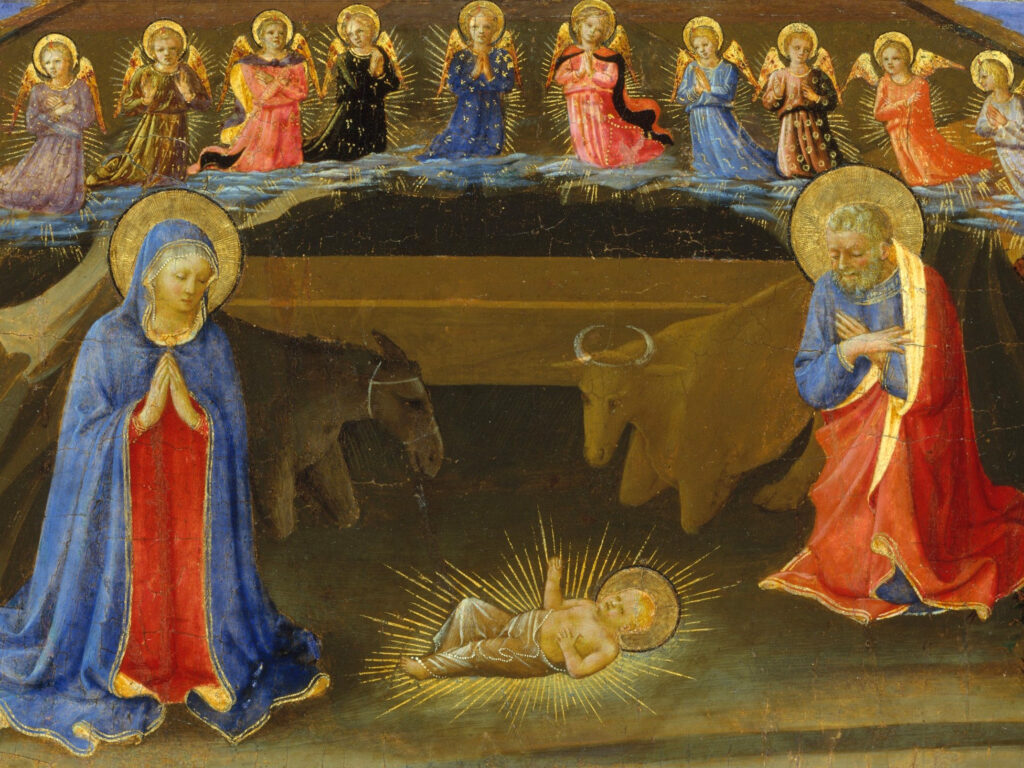
As we kneel before the warm and almost nostalgic nativity scene at Christmas, it is easy to forget the heights from which this holy Child has plunged in order to raise up a fallen humanity from the sin, poverty, fear, darkness and misery which held it captive. From “heaven’s royal throne”, the Eternal Word, being one in nature with God in the fullness of light and power, “emptied Himself, taking on the form of a slave” (cf. Phil 2:7-8). The Logos came into the darkness and narrowness of human existence, even into all the helplessness and vulnerability of a Child, shivering in a manger. He came to bear our burden, to expiate our sins by taking the punishment upon Himself on the Cross. And He descends even lower every day on our altars into the impotence and defenselessness of the Most Holy Bread, in order to feed and sustain us on our journey! What does this mean?! Are we still amazed by this wonderful love and condescension of God?
All humanity is poor. God comes to save us, the poor ones, you and me. Moved by compassion, God chose to become poor Himself—bitter poor—in solidarity with His creatures in order to expiate our sin, “for God so loved the world…” (Jn 3:16). In his first Apostolic Exhortation, Dilexi te [I have loved you], Pope Leo XIV writes of this incomprehensible love:
God is merciful Love, and His plan of love, which unfolds and is fulfilled in history, is above all His descent and coming among us to free us from slavery, fear, sin and the power of death. Addressing their human condition with a merciful gaze and a Heart full of love, He turned to His creatures and thus took care of their poverty. Precisely in order to share the limitations and fragility of our human nature, He Himself became poor and was born in the flesh like us. We came to know Him in the littleness of a Child laid in a manger and in the extreme humiliation of the Cross, where He shared our radical poverty, which is death. (Dilexi te 16)
God does not simply forgive our sin and forget; no, He wanted to manifest to mankind His merciful, selfless love by sending His Son, who “though He was rich, yet for your sakes He became poor, so that by His poverty you might become rich” (2 Cor 8:9).
There has always been, so to say, a “soft spot” in the Heart of God for the poor and He wants us, too, to share in His “preferential option” for the poor, for those even worse off than ourselves.
…This “preference” never indicates exclusivity or discrimination towards other groups, which would be impossible for God. It is meant to emphasize God’s actions, which are moved by compassion toward the poverty and weakness of all humanity. Wanting to inaugurate a kingdom of justice, fraternity and solidarity, God has a special place in His Heart for those who are discriminated against and oppressed, and He asks us, His Church, to make a decisive and radical choice in favor of the weakest. (Dilexi te, 16)
Thus Pope Leo reminds us of our calling and responsibility as members of Christ, as His Body, to love and care for the poor and the oppressed, and those enslaved by sin.
Poverty in the service of Redemption
The mission of Jesus is continued by His Church and all her members. The more closely we are united with Jesus, the more we will share in His voluntary poverty in the service of the Redemption. “Have among yourselves the same attitude that is also yours in Christ Jesus, who…emptied Himself, taking the form of a slave…” (Phil 2:5-7). In the synagogue of Nazareth, Jesus applies the prophet’s words to Himself saying, “The Spirit of the Lord is upon Me, because He has anointed Me to bring good news to the poor” (Lk 4:18; cf. Is 61:1). Pope Leo comments,
He thus reveals Himself as the One who, in the here and now of history, comes to bring about God’s loving closeness, which is above all a work of liberation for those who are prisoners of evil, and for the weak and the poor. …He opens the eyes of the blind, heals lepers, raises the dead and proclaims the good news to the poor: God is near, God loves you (cf. Lk 7:22). …And the Church, if she wants to be Christ’s Church, must be a Church of the Beatitudes, one that makes room for the little ones and walks poor with the poor, a place where the poor have a privileged place. (Dilexi te 20-21)
“You did it to Me…”
It is true, that the spiritual liberation and salvation of souls is the first and primary mission of Christ and His Church. But this is no excuse to forget or ignore the plight of the poor, the sick, the lonely and the suffering in the world around us.
…In hearing the cry of the poor, we are asked to enter into the Heart of God, who is always concerned for the needs of His children, especially those in greatest need. …On the wounded faces of the poor, we see the suffering of the innocent and, therefore, the suffering of Christ Himself. (Dilexi te 8-9)
And though the first and greatest commandment is love for God, nevertheless, this love cannot be separated from love and service toward our neighbor.
Love for our neighbor is tangible proof of the authenticity of our love for God, as the Apostle John attests: “No one has ever seen God; if we love one another, God lives in us, and His love is perfected in us” (1 Jn 4:12). …The two loves are distinct yet inseparable…. “Truly I tell you, just as you did it to one of the least of these My brethren, you did it to Me” (Mt 25:40). (Dilexi te 26)
This love of neighbor is to be both concrete and effective. St. James writes of living faith working through charity saying, “If a brother or sister is naked and lacks daily food, and one of you says to them, ‘Go in peace; keep warm and eat your fill,’ and yet you do not supply their bodily needs, what is the good of that? So faith by itself, if it has no works, is dead” (James 2:14-17). And in the words of St. John, “How does God’s love abide in anyone who has the world’s goods and sees a brother or sister in need and yet refuses help?” (1 Jn 3:17). Thus, through serving those who are in need and not expecting a return, we prove the genuineness of our faith in and love for God and are gradually freed from our own selfishness and hardness of heart. God teaches, purifies and transforms us—we learn and grow—through our service of the poor, “so that we may all become an image of Christ and His mercy towards the weakest” (Dilexi te 27).
Reading the Gospel aright
Though each of us rightly lives according to our state in life and calling, nevertheless, we are not to live like the people “of this world”, hoarding up goods to satisfy our own greed, pleasure-seeking or desire for well-being, comfort and social status, dismissing all concern for the poor with the thought, “They should help themselves!”
…In a world where the poor are increasingly numerous, we paradoxically see the growth of a wealthy elite, living in a bubble of comfort and luxury, almost in another world compared to ordinary people. This means that a culture still persists—sometimes well disguised—that discards others without even realizing it and tolerates with indifference that millions of people die of hunger or survive in conditions unfit for human beings. (Dilexi te 11)
We as followers of Christ, however, are to have a heart of compassion—the Heart of God Himself—for the poor, the suffering, the weak and the oppressed. Pope Leo exhorts,
The fact that some dismiss or ridicule charitable works, as if they were an obsession on the part of a few and not the burning heart of the Church’s mission, convinces me of the need to go back and re-read the Gospel, lest we risk replacing it with the wisdom of this world. The poor cannot be neglected if we are to remain within the great current of the Church’s life that has its source in the Gospel and bears fruit in every time and place. (Dilexi te 15)
It is true that much of the conditions of poorer communities and lands are beyond our power to change, stemming from unjust political and economic systems, waste, war, corruption and basic fallen human nature. And it is certainly more helpful to give a poor person a job than simply a handout. But on a day to day basis, making great changes in the world situation is mostly beyond our means. Almsgiving, however, is always possible—helping this person here and now, who is sitting on the street and begging for an alms, is within my reach. St. Mother Teresa of Calcutta once said, “I never look at the masses as my responsibility. I look at the individual. I can love only one person at a time. I can feed only one person at a time. Just one, one, one.” And as Pope Leo XIV so beautifully explains,
Almsgiving at least offers us a chance to halt before the poor, to look into their eyes, to touch them and to share something of ourselves with them. In any event, almsgiving, however modest, brings a touch of pietas into a society otherwise marked by the frenetic pursuit of personal gain. …Remaining in the realm of ideas and theories [of solving world poverty], while failing to give them expression through frequent and practical acts of charity, will eventually cause even our most cherished hopes and aspirations to weaken and fade away. For this very reason, we Christians must not abandon almsgiving. It can be done in different ways, and surely more effectively, but it must continue to be done. It is always better at least to do something rather than nothing. Whatever form it may take, almsgiving will touch and soften our hardened hearts. It will not solve the problem of world poverty, yet it must still be carried out, with intelligence, diligence and social responsibility. (Dilexi te 116, 119)
In his Exhortation, Pope Leo goes on to cite examples of the Saints and Christian communities of every age, beginning with the first Christians. We encourage you to download Dilexi te from the Vatican website and let yourself be inspired by these examples, especially in this season of Advent.
On the path to Bethlehem
Through the outpouring of the Holy Spirit, Jesus lives and loves and acts in and through His faithful by His divine Love. Yet His faithful ones will also share in His poverty, His self-emptying, as a manifestation of the totally selfless, self-giving Love of God that is to animate their lives. We think first of our Blessed Mother and St. Joseph, who conveyed Jesus to His birth and surrendered their whole lives to His Person and mission. Mother Gabriele describes the poverty they accepted and offered with love during this journey, in a Way of the Cross for Christmas Eve. Here we cite just a few stations.
“Mary comes to a marketplace. People are haggling and bargaining. It is crowded. St. Joseph has trouble clearing a narrow path for Mary along the houses. Here and there he catches a curious glance; this afflicts him, for a woman should no longer show herself before giving birth. Mary pulls her veil down lower. She does what God wills, no matter how difficult it may be for her. Look at Mary, O man of this earth, when on your Way of the Cross God demands of you self-denial (self-emptying) to the very end. God alone knows why it must be so. …
“The Soul of JESUS looks through His Mother, far beyond the city. He senses the opposition that comes…from the consequences of sin: the wealth of the property owners, who are closed in hard-heartedness to all need—and the poverty of the beggars along the roadside, who have no home, no shelter, no secure future through possessions. But behold: the poor man shares his bread with someone even poorer. So he still has love, a readiness to help, compassion, and mercy; and with that he resolves before God the opposition that comes from sin; for on account of his charity, God places him among those who are truly rich before God. This is where your path leads, Mother Mary, to the poor, the lowly, because they are still receptive and open for God. This is also where your Way of the Cross leads, brother, sister—in the direction of love and mercy….
“Shepherds point to an empty stable, used only by passing herds. A few animals graze outside; in the stable there is straw and some hay. O most bitter poverty! No mother, no soft bed, no helping woman’s hand awaits Mary here. God has made her truly destitute. Like the poorest beggar on the roadside, she must seek shelter for her hour here. This station is that of the deepest impoverishment; it is also the holy touchstone of fidelity. Stripped of all earthly possessions, abandoned by men, St. Joseph lays the tired Mother on the hard-packed earth, on which he spreads the few blankets they had brought with them. Silently and patiently, both surrender themselves to the Most Holy Will of God.” (Mother Gabriele Bitterlich, Mary’s Way of the Cross on the Vigil of Christmas).
Though later the conditions improve for the Holy Family (the Magi entered the house and no longer the stable—cf. Mt 2:11), nevertheless, God requires of His closest friends again and again that they be ever ready to abandon all, that they rely only on Him rather than worldly support and security, that they surrender to His holy Will in every situation with great trust and fidelity, realizing that our true and eternal happiness lies only in Him. This is at the same time a trial of faith and expiation for the so many who are turned only to this world. And the Holy Family goes before us on this way as an example of the ultimate obedience and fidelity, of extreme detachment from the goods and values of this world—out of love for God and souls. Pope Leo expounds:
The Gospel shows us that poverty marked every aspect of Jesus’ life. …Jesus was born in humble surroundings and laid in a manger; then, to save Him from being killed, they fled to Egypt (cf. Mt 2:13-15). At the dawn of His public ministry, after announcing in the synagogue of Nazareth that the year of grace which would bring joy to the poor was fulfilled in Him, He was driven out of town (cf. Lk 4:14-30). He died as an outcast, led out of Jerusalem to be crucified (cf. Mk 15:22). …He experienced the same exclusion that is the lot of the poor, the outcast of society. …He presented Himself to the world not only as a poor Messiah, but also as the Messiah of and for the poor. (Dilexi te 19)
Though He might not ask such radical poverty of us, nevertheless, every follower of Christ must be ready to choose God over the goods of this world when the situation demands it of him.
Jesus says of Himself: “Foxes have holes, and birds of the air have nests; but the Son of Man has nowhere to lay His head” (Mt 8:20; Lk 9:58). He is, in fact, an itinerant teacher, whose poverty and precariousness are signs of His bond with the Father. They are also conditions for those who wish to follow Him on the path of discipleship. In this way, the renunciation of goods, riches and worldly securities becomes a visible sign of entrusting oneself to God and His Providence. (ibid. 20)
This poverty and entrusting of self to God is a sign in that we point to “a better homeland, a heavenly one” (Heb 11:16). For while they can be good and useful, the goods of this world are only relative and can never satisfy, as St. Augustine writes, “My heart is restless until it rest in You!” and St. Teresa of Avila, “God alone suffices.” It is this truth which also inspired the rich young Francis of Assisi to embrace radical poverty with joy and burning love for God in service of the Church, of sinners and of the poor, while the rich young man of the Gospel “went away sad” (Lk 18:23). Which rich young man am I?
Poverty of the Guardian Angel?
There are others at our side, whom we do not see nor ever imagine as “poor”, yet who are intimately involved in the Redemptive mission of Christ, and thus share deeply in His messianic poverty: the holy Angels—in particular, our own good Guardian Angel! Mother Gabriele explains this “poverty” of the Guardian Angel and his sharing in the Passion of Christ in a Way of the Cross of the Guardian Angel:
The first station begins for the blessed Angel above, before the throne of GOD, when he is called to the office of Guardian Angel. This service is for him a special call and election, because it is a participation in the work of Redemption. He gives thanks with joy, even though he recognizes the depth and darkness, indeed, the horror and narrowness into which he must descend on earth. But did not God’s Son, His Lord, also leave the throne above all the heavens and enter into the same depths and darkness, indeed, into an even greater narrowness, into the womb of a human being, and take on the restricted mortal nature of a human being with all its needs?
In the second station, the Angel descends in obedience into the depths. The light-flooded glory of heaven remains behind and on earth he is received by dark faith, dark hope, dark love; these are now his walking stick and support. He does not know the future of his protégé, he does not know how he will decide, he does not know whether he will be able to save him and bring him Home.
In the eighth station, the Angel sees [in his particular case] how other Guardian Angels take joy in their protégés and can guide them easily. But he must recognize ever more clearly with anxious concern that his protégé is resisting the Church and God, that he prefers to chase after the delusive light of unbridled freedom and craving for life, that he is falling deeper and deeper into darkness because of the many delusive lights.
In the ninth station, his protégé slips away from him [namely, into self-will or even serious sin]. And yet the Angel is bound to him and now enters upon the active imitation of Christ. What man must suffer physically and in his soul in all kinds of crosses, and what the Guardian Angel must endure spiritually in this imitation of Christ in renunciation and shame, Our Lord has taken all this into His PASSION – and unto the end of time. Here, from this ninth station onwards, the Lord and His faithful ones, Angels and humans alike, whom He calls upon to work for the salvation of the world, each at his place and in his task, are one. And at no other point can the Angel come so close to the God-man Jesus Christ in His redemptive work on earth as in this final phase of the struggle for the immortal soul of man, for the salvation of the whole man for eternity….
We see, then, that even the Angel accepts his powerlessness by God’s will and becomes poor in order to work with Christ for the salvation of souls. He becomes poor to help the poor: his protégé living in the darkness of this world. Like our Angel, we too want to be poor, at least in spirit, to empty ourselves and give ourselves in service of souls—by loving expiation—and of the poor, by generous material giving. “I am convinced that the preferential choice for the poor is a source of extraordinary renewal both for the Church and for society, if we can only set ourselves free of our self-centeredness and open our ears to their cry” (Pope Leo XIV, Dilexi te 7).
Getting concrete
There are many forms of poverty and many ways of serving the poor; much depends upon our means and state of life. While in the Work of the Holy Angels we serve the poor sinners through our consecration of expiation, for example, for an overburdened Bishop, a straying priest or religious—which is a consecration of love and sacrifice, like the self-giving poverty of the Guardian Angel—as Christians we should also be practicing service of the material poor. Our Guardian Angel will show the way, if we are open and vigilant.
Concrete suggestions? How about visiting a nursing home and spending time, praying or just chatting with someone who has no family—and don’t forget the flowers! Bringing an extra sandwich along and a miraculous medal when we visit a big city, where we inevitably encounter a beggar—and ask his name! Making meals for a family welcoming a new child or grieving the loss of someone—with dessert! Praying and/or counseling before an abortion mill, or volunteering at a pregnancy aid center. Teaching catechism at our parish or joining a soup kitchen team. Visiting the sick or an orphanage, or praying with the dying. Joining the Legion of Mary, the Knights of Columbus or the St. Vincent de Paul Society. Prison ministry. Being near to someone struggling or feeling unloved in our own homes, for charity begins at home! None of the above? Everyone can pray and make sacrifices: for victims of natural catastrophes or the persecuted Christians. We want to be creative and walk with open eyes and ears!
We should be humbly aware, however, that both the spiritually and materially poor give to us perhaps even more than we give to them—especially through the slow transformation of our hearts into hearts of flesh. And possibly more important than the material help is that we also become a sign for the poor, a spiritual experience for them of God’s nearness and love.
By its very nature, Christian love is prophetic: it works miracles and knows no limits. It makes what was apparently impossible happen. …Through your work, your efforts to change unjust social structures or your simple, heartfelt gesture of closeness and support, the poor will come to realize that Jesus’ words are addressed personally to each of them: “I have loved you” [“Dilexi te”] (Rev 3:9). (Dilexi te 120-121)
Before the manger we want to remember that we ourselves are the poor ones, whom God has come to save, to free, to enrich with His love and grace! And we want to renew our commitment to follow Him, to love and serve Him, especially in the most vulnerable and suffering, the poor through material help, and the poor sinners through expiation. “How much we have to thank before the manger, and to promise! Let us take it seriously, our life, our mission, our promise!” (Mother Gabriele, Children’s letters, Dec 18, 1963) smb
The texts of the Circular Letters are copyrighted and may not be reproduced without written permission.
©2021 Opus Sanctorum Angelorum Inc.
Back to Meditations Index →